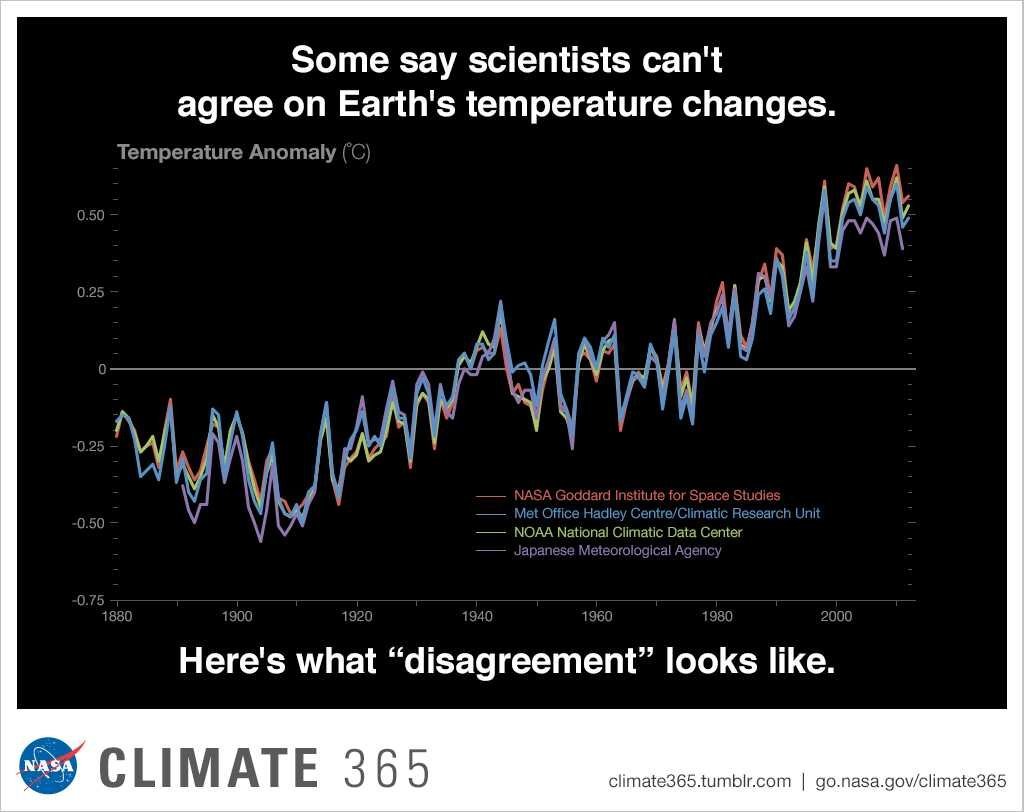
Току що ти обясних подробно, че не значи точно това, ако обичаш върни се към предния ми коментар и го прочети отново много внимателно. Това е средната температура на всички измерени температури от отделни точки на земята, тези температури са най-различни, като ги събереш получаваш това. Наистина не знам как по-ясно мога да го обясня, но не смятам пък, че е нещо чак толкова сложно за разбиране. Ето още един линк от НАСА, където много подробно обясняват същото:
The global temperature record represents an average over the entire surface of the planet. The temperatures we experience locally and in short periods can fluctuate significantly due to predictable cyclical events (night and day, summer and winter) and hard-to-predict wind and precipitation patterns. But the global temperature mainly depends on how much energy the planet receives from the Sun and how much it radiates back into space—quantities that change very little.
A one-degree global change is significant because it takes a vast amount of heat to warm all the oceans, atmosphere, and land by that much. In the past, a one- to two-degree drop was all it took to plunge the Earth into the Little Ice Age. A five-degree drop was enough to bury a large part of North America under a towering mass of ice 20,000 years ago.
As the maps show, global warming doesn’t mean temperatures rose everywhere at every time by one degree. Temperatures in a given year or decade might rise 5 degrees in one region and drop 2 degrees in another. Exceptionally cold winters in one region might be followed by exceptionally warm summers. Or a cold winter in one area might be balanced by an extremely warm winter in another part of the globe.
https://earthobservatory.nasa.gov/world-of-change/DecadalTemp
Не с ликове от статии
Това е линк към сайта на НАСА. Влизаш вътре и четеш, хората са дали и други линкове с подробна информация, данни и т.н.
https://data.giss.nasa.gov/gistemp/
Както казах първо влизаш, четеш и след това пишеш.
Виж целия пост
The global temperature record represents an average over the entire surface of the planet. The temperatures we experience locally and in short periods can fluctuate significantly due to predictable cyclical events (night and day, summer and winter) and hard-to-predict wind and precipitation patterns. But the global temperature mainly depends on how much energy the planet receives from the Sun and how much it radiates back into space—quantities that change very little.
A one-degree global change is significant because it takes a vast amount of heat to warm all the oceans, atmosphere, and land by that much. In the past, a one- to two-degree drop was all it took to plunge the Earth into the Little Ice Age. A five-degree drop was enough to bury a large part of North America under a towering mass of ice 20,000 years ago.
As the maps show, global warming doesn’t mean temperatures rose everywhere at every time by one degree. Temperatures in a given year or decade might rise 5 degrees in one region and drop 2 degrees in another. Exceptionally cold winters in one region might be followed by exceptionally warm summers. Or a cold winter in one area might be balanced by an extremely warm winter in another part of the globe.
https://earthobservatory.nasa.gov/world-of-change/DecadalTemp
Не с ликове от статии
Това е линк към сайта на НАСА. Влизаш вътре и четеш, хората са дали и други линкове с подробна информация, данни и т.н.
https://data.giss.nasa.gov/gistemp/
Както казах първо влизаш, четеш и след това пишеш.